 New
New
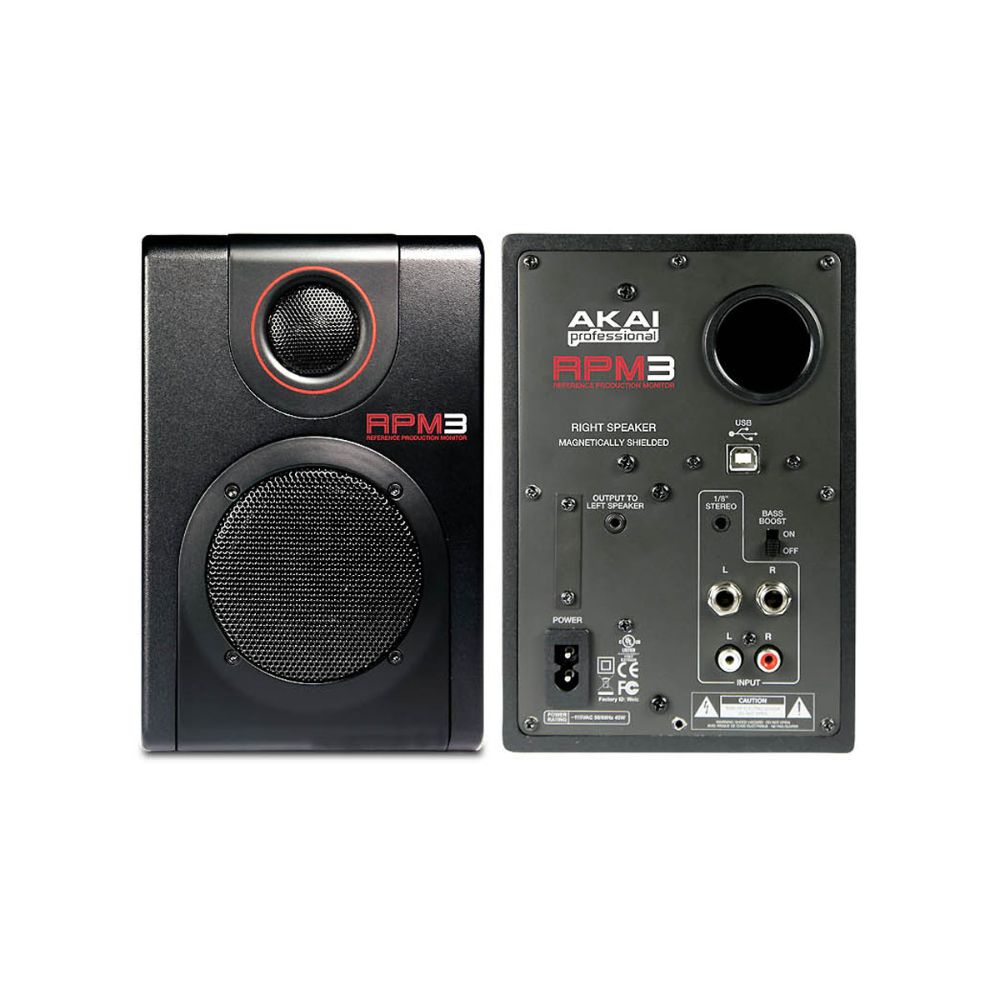
The Akai Professional RPM3 Production Monitors deliver an innovative, space-saving desktop solution that combines compact 2-way active reference speakers with a built-in 2×2 USB audio interface. Equipped with a 3-inch polypropylene woofer and a 1-inch silk dome tweeter per cabinet, this magnetically shielded system provides clear near-field tracking while allowing you to simultaneously play and record 16-bit/48kHz audio directly into your computer over a single USB cable. Featuring flexible rear analog connection paths including balanced 1/4-inch, RCA, and 1/8-inch inputs, the master speaker houses convenient front-panel controls alongside an acoustic bass boost switch on the back. Available today at our central Beirut showroom, it is the perfect dual-purpose travel or project studio setup for Lebanese electronic music producers, content creators, and mobile recordists looking to maximize desktop efficiency without compromising on clean input routing.
Streamline your mobile tracking workspace and clear your desktop clutter with the Akai Professional RPM3 Production Monitors. Cleverly engineered to function as both a high-fidelity monitoring system and an integrated recording tool, these ultra-compact reference speakers solve a major problem for modern music creators by packing a full 2×2 USB audio interface directly into the speaker cabinet. Measuring just 6.0 by 5.0 inches per enclosure, the RPM3 system claims an incredibly small desktop footprint while offering an immediate, travel-ready monitoring canvas. Because it is completely plug-and-play with a class-compliant driver architecture, you can toss them into a travel case, head out to a field session, and immediately track or playback high-resolution audio over a single USB link without carrying separate standalone interface boxes or power bricks.
The internal sound engine of the RPM3 utilizes a classic 2-way active bi-amplified layout that delivers a surprisingly wide, full-range frequency response for its micro scale. Each speaker houses a 3-inch lightweight polypropylene woofer cone with a high-torque rubber surround, paired with a specialized 1-inch silk dome tweeter to supply crisp, natural high-end details and balanced mids. To preserve the health of your master signal and protect neighboring storage media, both cabinets are fully magnetically shielded. This means you can position the monitors immediately alongside massive desktop computer screens, LED rigs, or analog hard drives without introducing ground hums, visual distortion lines, or magnetic noise interference to your working setup.
Record premium external gear and track live inputs without encountering software processing delays:
Built-In 2×2 USB Audio Interface: Pipes simultaneous multi-channel 16-bit digital audio recording and crystal-clear computer playback back and forth over a single data link.
Hardware Zero-Latency Monitoring: Features direct physical internal analog routing so inputs connected to the rear pass instantly to the drivers without passing through a DAW round-trip buffer.
Acoustic Bass Boost Switch: Outfitted with a physical 2-position toggle on the rear panel to inject a calibrated +4.8dB bump at 100Hz, beefing up low-end response in sparse mixing environments.
Multi-Format Analog Inputs: Dedicated rear connection points hosting separate pairs of balanced 1/4-inch TS lines, stereo RCA chains, and an auxiliary 1/8-inch (3.5mm) stereo input jack.
Front-Panel Master Controls: Access power switching, continuous volume adjustments, and a dedicated 1/8-inch silent practice headphone jack right on the face of the master active cabinet.
Maintain absolute accuracy across home project spaces and on-the-road travel rigs:
High-Resolution 48kHz Converters: Utilizes internal delta-sigma ADC/DAC processing to sample incoming audio cleanly at 44.1kHz or 48kHz for pristine digital DAW tracking.
Efficient 10W RMS Per Channel Amplification: Drives clean, undistorted active power across your close-range desk space without throwing off your structural room acoustics.
Rigid Bass-Ported Cabinets: Tuned rear airflow chambers maximize small-woofer punch and prevent internal cabinet air compression during heavy sub-bass hits.
🎛️ Zero-Latency Interface Routing Pro-Tip: The RPM3 behaves uniquely because it captures whatever analog signal is plugged into its rear 1/4-inch or RCA inputs and encodes it straight to your DAW via the USB cable. If you connect a hardware synthesizer or a microphone preamp directly to the back of the monitors, you will hear your performance instantly through the drivers via the speakers’ hardware zero-latency path. To avoid a double-monitoring “flanging” effect when tracking into software platforms like Ableton Live or Logic Pro, ensure that you turn off the “Software Input Monitoring” toggle inside your specific DAW track lane.
The granular hardware acoustics, interface conversion specs, and connectivity routing paths are detailed below:
| Engineering Attribute | Hardware Configuration Specification | Production Workflow Advantage |
| Acoustic Driver Core | 3” Polypropylene Cone Woofer & 1” Silk Dome Tweeter | Delivers highly accurate, balanced frequency reproduction for small rooms. |
| Integrated Interface | 2-Input / 2-Output Class-Compliant USB Interface | Eliminates the need for a separate audio interface box on your production desk. |
| Digital Resolution | 16-Bit Delta-Sigma Delta Converters (44.1kHz / 48kHz) | Tracks crystal-clear, studio-standard audio signals straight into your software DAW. |
| Amplifier Delivery | 10 Watts RMS Continuous Power per Channel | Provides plenty of clean near-field listening volume without causing ear fatigue. |
| Frequency Register | 80 Hz – 20 kHz Acoustic Playback Range | Captures sparkling high-end detail while staying compact enough for travel. |
| Acoustic Contouring | Dedicated Rear Bass Boost Switch (+4.8dB at 100Hz) | Instantly extends low-frequency presence to compensate for smaller rooms. |
| Rear Analog Inputs | 2x 1/4″ TS Jacks, Stereo RCA Pair, 1x 1/8″ Stereo Input | Accommodates mixers, keyboards, guitar modelers, and line gear simultaneously. |
| Front Facing I/O | Combined Power/Volume Dial, 1/8″ Headphone Jack | Provides quick access to master volume adjustments and silent monitoring shifts. |
| Magnetic Protection | Full Structural Magnetic Cabinet Shielding | Allows you to place the monitors safely next to laptops, displays, and media drives. |
| System Proportions | 6.0″ x 5.0″ x 7.5″ / 15.3 cm x 12.7 cm x 19.0 cm (Per Cab) | Ultra-slim design that drops easily into standard flight gear bags or tight desks. |
| Hardware Net Weight | 7.5 lbs (3.4 kg) Total Combined Master/Slave Weight | Rests securely on your desk surface while remaining remarkably lightweight for travel. |
No. The Akai RPM3 utilizes a completely class-compliant, plug-and-play USB connection protocol. When you hook up the speakers to your computer using the provided USB cable, the operating system (compatible with Windows 11 and macOS) instantly recognizes the monitors as an integrated sound card. You simply select “RPM3” as your default Input and Output device inside your computer’s sound preferences or your favorite DAW software.
The rear 1/4-inch and RCA input jacks are configured to accept line-level audio signals. This means they are ideal for directly connecting a hardware synthesizer, drum machine, DJ mixer, or guitar multi-effects processor. If you want to record an electric guitar or a microphone, you should run them through an external instrument preamp, a DI box, or a compact mixing console first to raise their signals to line-level before plugging into the RPM3 inputs.
The RPM3 system operates on a classic Master/Slave speaker layout. The right speaker cabinet houses the integrated amplifier, audio interface, power transformer, and all physical audio input connections. The package includes a standard 1/8-inch (3.5mm) link cable that routes the amplified left-channel audio signal out from the rear of the right cabinet over to the physical input jack on the passive left speaker.